OODVS-Object Oriented Distributed Virtual Systems(C) Copyrigth 2003 by
Diego Ernesto Malpica Chauvet
|


|
1 Description
OODVS is a library which
goal is to increase the Java support for Distributed Virtual
Systems providing local access to distributed resources via
proxies. Our main componets are Participants,
Entities, Proxy Enties, Proxy Methods , Remote Methods and Migratory Objects.
1.1 License
This library is free
software; you can redistribute it and/or modify it under the terms
of the GNU Lesser General Public License as published by the Free
Software Foundation; either version 2.1 of the License, or (at
your option) any later version. This library is distributed in the
hope that it will be useful, but WITHOUT ANY WARRANTY; without
even the implied warranty of MERCHANTABILITY or FITNESS FOR A
PARTICULAR PURPOSE. See the GNU Lesser General Public License for
more details. You should have received a copy of the GNU Lesser
General Public License along with this library; if not, write to
the Free Software Foundation, Inc., 59 Temple Place, Suite 330,
Boston, MA 02111-1307 USA.
1.2 Downloads
Home page: http://oodvs.sourceforge.net
Project page: http://sourceforge.net/projects/oodvs
Downloads: SourceForge
Files.
CVS Project modules for
Eclipse 3.0.2: SourceForge
CVS.
1.3
Contact Information
Mail: Diego Ernesto Malpica Chauvet,
Coleadero 71, Villas de la Hacienda,
Atizipan de Zaragoza,CP 52929,
Estado de Mexico,
Mexico.
TOC
1.4
Table of contents
1
Description
2 Main
components and Roles
2.2 Entities
2.3 Proxy Entities
2.4 Proxy Methods
2.5 Remote Methods
2.6 Regions
2.7 Time Perception
2.8 Security
2.9 Migratory Objects
3 Simple Examples
3.2 Remote Method Invocation
3.3 Remote Method Invocation Protocols
4
Advanced Examples
5 Glossary
TOC
2 Main components and
Roles
2.1 Participants
Holds the entities.
Interact
with local entities to update their proxies
Interact with the proxies to update states
Interact with other
participants to distribute proxies
Propagate proxies between
regions
Send heart beats to plublish himself to other
participants.
Listen for other participants hear beats.
Remove dead
asumed participants
Send proxies of new entities to known
participants
Send proxies of its entities to new
known participants
Provides classes and resources to
other participants
2.2 Entities
Contains state information
Contains references to its proxy entities
Contains
methods and Proxy methods
2.3 Proxy Entities
Is a entity thats has a parent entity.
Contains a references to a root entity.
Could be the
parent of other proxy entitites.
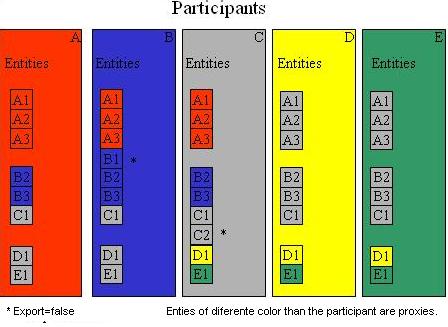
2.4 Proxy Methods
Are used to propagate messages to the root entity and all its
proxy entities. Currently there are two implementations TCP
Proxy (TCPP) and UDP Proxy (UDPP).
2.5 Remote Methods
This is are kind of RMI , RPC services that does not need a external tool to create stubs or skelletons. Currently there are various protocolos implemented over HTTP/TCP and UDP(Broadcast and Multicast). They have serveral security features like RSA,RC4 key generetation, RSA signing, RSA/RC4 encryption. The semantics are very similar to the RMI semanthics, but disigned to support the implementation of Proxy methods.
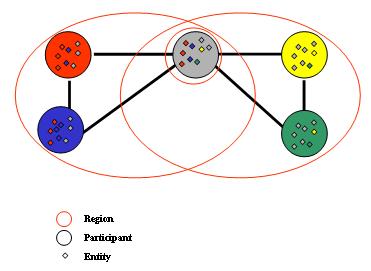
2.6 Regions
Regions are defined by the visibility determined by a set of
castAddresses (broadcast and multicast) especified in the
participant.
2.7
Time Perception
The time services allows to have diferent times and clock
speeds and to mitigate network latency effects. It is used in
conjuntion with prediction and convergence algoritms like the Dead
reckoning implemented in avanced examples.
2.8 Security
Several crypto services will be provided mainly thru
the Remote Methods stack. There is also pending work in order to
secure the ClassLoader used to suport the Mitratory objects.
2.9 Migratory objects
Full objects (code and data) are moved between participants a participan can retrieve code and resources on demand from other participants.
TOC
3 Simple Examples
3.1 Object
Oriented Distributed System
These are the interface and class used in the followind code
fragments.
Two proxy methods are implemented, with names
terminated with TCPP an UDPP that stands for TCP Proxy method
and UDP proxy method.
| public interface EntityExample_I { public void printMsg_TCPP(String msg) throws RMClientException; public void printMsg_UDPP(String msg) throws RMClientException; } |
|
public class EntityExample extends Entity implements EntityExample_I {
public EntityExample(String name) throws
RMClientException {
public void printMsg_TCPP(String msg) throws
RMClientException {
public void printMsg_UDPP(String msg) throws
RMClientException { } |
The next code part creates a participant "A" and adds a Entity
"A1" to it.
A proxy handler of entity "A1" is obtained.
The proxy handler is used to invoke the two proxy
methods, the handler uses the prefix of the method name
(UDPP,TCPP) to determine how to handle the method invocation.
|
Participant a = new Participant("A").start(); EntityExample_I handler= (EntityExample_I) a.getHandler("A1",0);
handler.printMsg_UDPP("hello 1."); |
The next code part creates a participant "B".
Participants "A" and "B" will eventualy discover each other and
send proxys to each other.
After particpant "B" is
created a proxy for the entity "A1", will be retrieved.
Then the local method getName of the proxy will be invoked.
Finally a proxy handler for the proxy "A1" will be obtained
Then the handler will be used to invoke the a proxy method.
|
Participant b = new Participant("B").start();
EntityExample proxy = (EntityExample) b.getEntity("A1",0);
handler = (EntityExample_I)proxy.getHandler(); |
TOC
3.2 Remote Methods
These are the interface and class for the object to be used
for remote method invocation in the next code fragments.
| public interface ObjectExample_I { public String msg1(String name) throws Exception; } |
| public class ObjectExample implements
ObjectExample_I { public String msg1(String str) { System.out.println(str); return "RE: "+ str ; } } |
This is the server part.
A remote method server is created and started .
An
object is created and added to the server to be ready
for remote invocations.
| RMServer server = new RMServer().start(); server.putObject("O1", new ObjectExample()); |
This is the client part, a handler is created and used to perform the remote method invocation.
|
RMClientContext cc = new RMClientContext("HTTP://localhost"); |
TOC
3.3 Remote
Method Protocols
These are the interface and class for the object to be used
for remote method invocation in the next code fragments.
| public interface ObjectExample_I { public String msg1(String name) throws Exception; } |
| public class ObjectExample implements
ObjectExample_I { public String msg1(String str) { System.out.println(str); return "RE: "+ str ; } } |
This is the server part.
This code part firts creates
and intializes the server if the keyDir and keys does
not exists it will be created.
UDP information is
especified as part of the initialization for UDP remote method
invocations.
Finally the server is started.
An
object is created and added to the server to be ready for remote
method invocation.
|
FileUtils.mkdirs("keyDir"); server.putObject("O1", new ObjectExample()); |
This is the client part, a RMClientContext is created and used to obtain handlers to perform remote method invocations using various protocols.
|
RMClientContext context;
ObjectExample_I handler;
handler = (ObjectExample_I)
context.getHandler(RMClient.RM_UDP_V1_0,
ObjectExample_I.class, "/O1");
handler = (ObjectExample_I)
context.getHandler(RMClient.RM_HTTP_SIG_V1_0,
ObjectExample_I.class, "/O1"); |
TOC
4 Advanced Examples
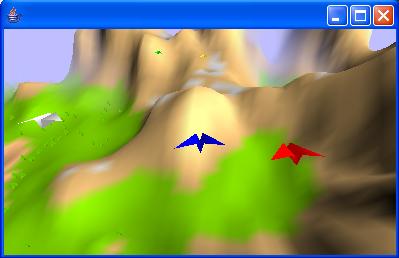
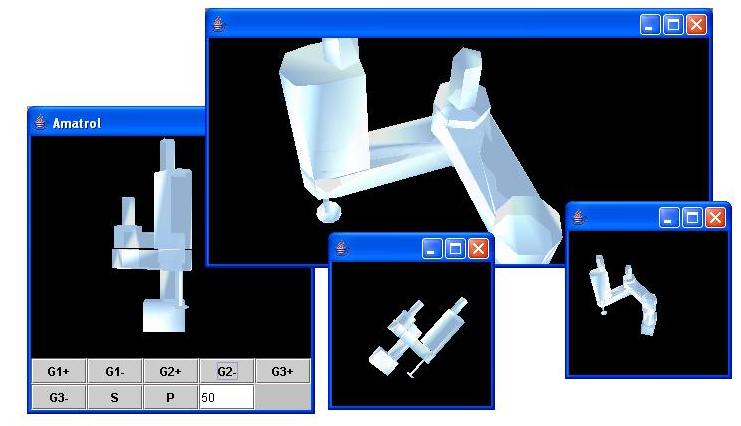
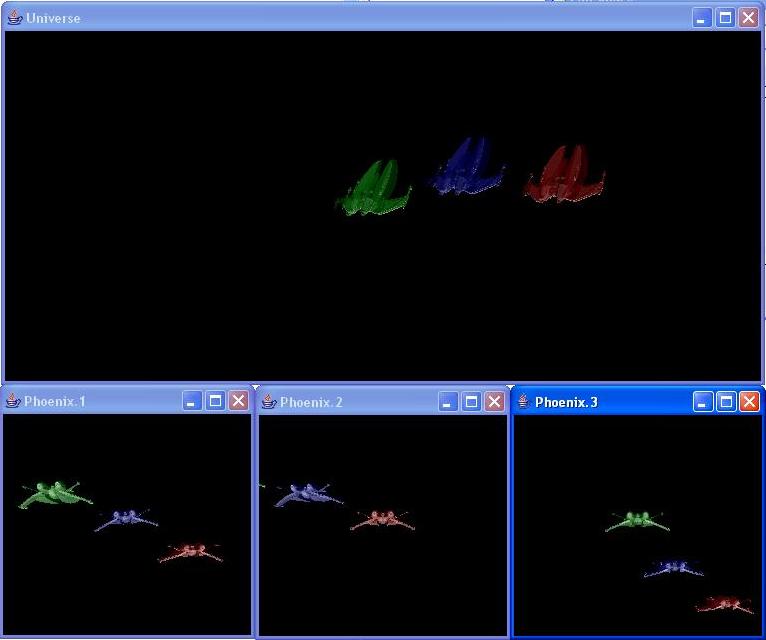
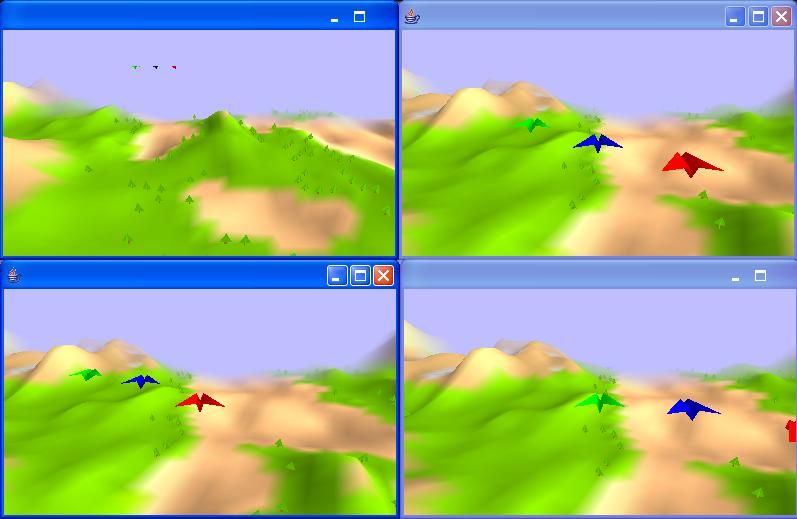
Every window in these examples is a diferente participant, each
participant sees it entites and proxy enties of other
participants. This examples ilustrates the implemtation of
physics predictive and convergence algorithms, an various
visualization techniques using OODVS.
4.1 Amatrol (J3D)
TOC
4.2 Phoenix (J3D)
TOC
4.3 Plane (Open GL)
TOC
5 Glossary
OODVS Object Oriented Distributed Virtual Systems
RMI Remote Method Invocation (TCP,UDP,HTTP)
RPC Remote Procedure Call
TCP Transmission Control Protocol
UDP User Datagram Protocol (broadcast and multicast)